Risk & Psychology · beginner · 7 min
Journalling
Memory is a terrible record of your own trading. It smooths the losses, sharpens the wins, and quietly rewrites why you took a trade to match how it turned out. Ask someone how their month went and you'll get a story; ask their journal and you'll get the truth, and the two are rarely the same. A trade journal is the only honest feedback loop a trader has, and this lesson is about why that is and what to put in one.
Why memory can't be trusted here
Two of the biases covered in Common Biases attack trading records specifically:
- Hindsight bias rewrites your reasoning after the outcome is known. A trade you took on a coin-flip whim becomes, in memory, a trade you "read perfectly" — if it won. The uncertainty you actually felt at entry is edited out.
- Recency and selective memory overweight the last few trades and the most dramatic ones. Three vivid winners can convince you a strategy is working while the ledger shows you are down on the month.
A journal defeats both by recording the reasoning at the moment of the trade, before the outcome is known to colour it. That timestamped, outcome-blind record is the whole point. It is the difference between "I think I'm disciplined" and knowing whether you are.
What actually belongs in a journal
The outcome — the profit or loss — is the least useful thing to log, because it's the one thing you'll remember anyway. The valuable entries are the ones that let you audit your process:
- The setup and the reason for entry — what you saw, in words, before it played out.
- Risk per trade — the fraction of the account staked (the discipline from Position Sizing). Logging this is how you catch yourself sizing up after wins and down after losses.
- Where the stop was and why — so you can tell a stop that was hit from a stop you moved.
- Whether you followed your own rules — a simple yes/no is often the single most revealing column in the whole log.
- State of mind, briefly — bored, revenge-trading, chasing. The pattern only shows up over dozens of entries.
- The outcome, last — points or P&L, recorded but not dwelt on.
Over enough trades this turns into data you can actually question: does my win rate hold up, or does it lean on a few outsized trades? Do my rule-breaks make or lose money? Am I holding risk constant? None of these can be answered from memory, and all of them can be answered from a log.
The journal and calendar in Visor
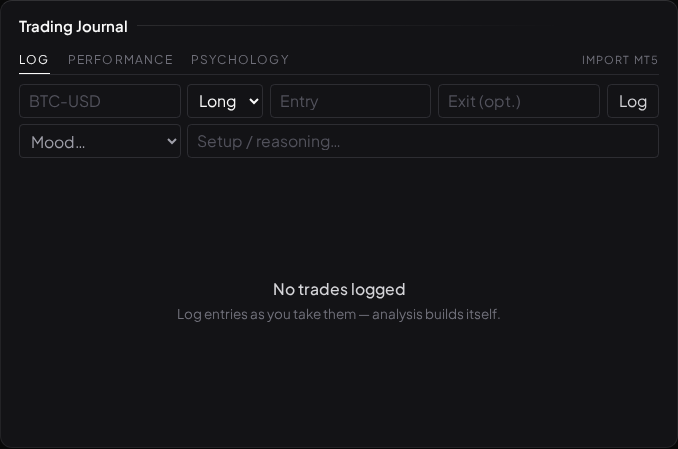
The Trading Journal widget records trades with P&L grouped by day, per-day subtotals and running totals, and a stats strip across the top. If you trade on MT5, it imports the broker's report directly, so the record is the broker's numbers rather than your recollection of them. The point of importing rather than re-typing is the same point as the whole lesson: remove yourself, and your memory, from the record-keeping.
The Trading Calendar widget is the same information seen from above — each day coloured by its result, auto-populated from the journal, with room for a manual note on any day. Zooming out to the calendar surfaces things a trade-by-trade list hides: clusters of red on particular weekdays, a run that followed a big win, the day you broke your rules and the week it took to recover. The trade list shows the trees; the calendar shows the forest.
The honest use of it
A journal is a mirror, not a coach. It will not tell you what to trade and it makes no promise that logging trades makes them profitable — a losing approach that is meticulously journalled is still a losing approach. What the journal does is make the losing visible and specific, early enough to do something about it, instead of hidden behind a comfortable story. That is its entire value: it replaces the account of your trading you'd like to be true with the one that is.
Used honestly, the journal is also the raw material for the harder question this track keeps returning to — whether you have a real edge or a run of luck. A long, clean log is the input; the gates in Reading a Robustness Report are how you interrogate it.
What to read next
- Common Biases — the mental edits a journal exists to catch.
- Position Sizing — the risk-per-trade number worth logging on every entry.
- Drawdown and Recovery — reading the runs of red the calendar makes visible.