Market Basics · beginner · 7 min
What Moves Markets
"Why did it move?" is the most-asked question in markets and the one most often answered with mysticism. Here is the un-mystical version. Prices move for one mechanical reason, dressed up in a thousand costumes.
The one mechanism: supply and demand
A price is just the level at which a buyer and a seller agree to trade right now. It moves when that balance tips:
- More eager buyers than sellers at the current price → buyers have to bid higher to get filled → price rises.
- More eager sellers than buyers → sellers accept lower to get out → price falls.
That's it. Every other explanation — earnings, rate decisions, a war, a tweet — is really a story about why the balance of buyers and sellers tipped. Supply and demand is the mechanism; everything else is a reason feeding into it. Keep that distinction and market commentary stops sounding like magic.
News: information that changes minds
The most visible trigger is news — an earnings report, an economic release, a central-bank decision, a geopolitical event. News moves price when it changes what participants believe an asset is worth, which changes whether they want to buy or sell it, which tips the balance.
Two honest subtleties that trip up beginners:
- It's the surprise that moves price, not the fact. Markets are forward-looking and price in expectations ahead of time. A company can post record profits and fall — because the market expected even more. What moves price is the gap between the news and what was already anticipated.
- The reaction isn't always "logical". Price can shrug off huge news and lurch on something minor, because what matters is how it lands against positioning and expectations, not the headline's apparent importance.
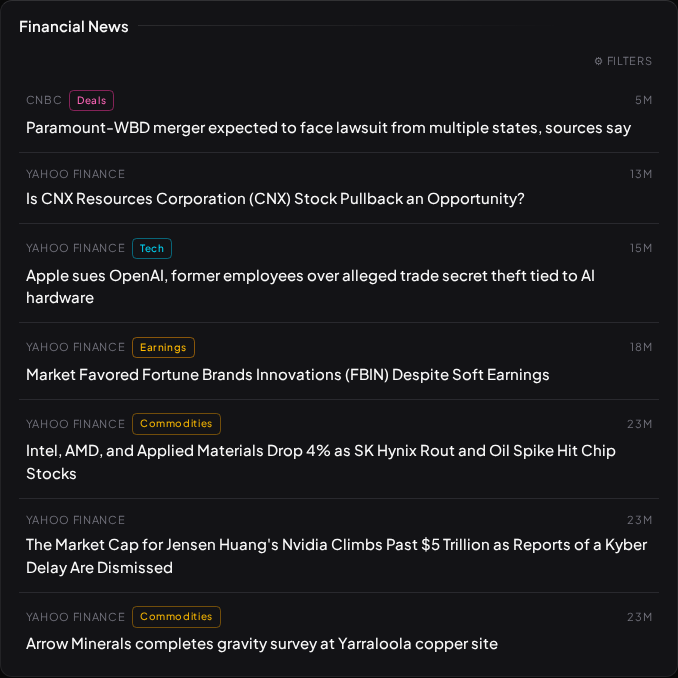
This is why a news headline is not a trade signal. It's context. In Visor, the Financial News widget and the SOOS Feed surface headlines and, where available, a short AI-generated read attached to each — and that read is labelled as AI-generated and can be wrong. Both are there to help you notice and understand what's happening, phrased as observations, never as instructions to act. See Reading the Feed for exactly what the feed does and doesn't claim.
Flows: the buying and selling itself
Underneath the reasons sits the raw plumbing — flows, the actual buy and sell orders hitting the market. Sometimes price moves with no fresh news at all, purely because of who is transacting:
- A large fund rebalancing its portfolio.
- Index funds mechanically buying or selling to track their benchmark.
- Options dealers hedging their books (a flow Visor's options-analytics widgets try to make visible).
- Leveraged positions being force-closed, which can cascade.
Flows are why markets can move "for no reason" — the reason is simply that someone large needed to trade, regardless of the news. Reading flow directly is the whole subject of the tape-reading track; What Is Order Flow starts there.
Putting it honestly
So a real move is usually some blend: a piece of news shifts expectations, which changes demand, which shows up as flow, which moves price — and the commentary written afterward picks whichever story sounds tidiest. Two cautions worth carrying:
- After-the-fact reasons are cheap. There's always a headline available to "explain" any move once it's happened. That a story fits in hindsight doesn't mean it was predictable, or that it'll work as a rule next time — the gap between looks obvious afterwards and holds up out-of-sample is exactly what The Overfitting Trap is about.
- Understanding why ≠ knowing what's next. Grasping the mechanism helps you read the market; it is not a forecast, and nothing here suggests a way to profit.
What to read next
- Volume and Liquidity — the size behind the flows.
- Reading the Feed — how Visor surfaces news as observation, not instruction.
- What Is Order Flow — watching the buying and selling directly.