Strategies · intermediate · 8 min
Building Your Own
Everything in this track has been building to one habit: take an idea, turn it into a precise rule, and let the robustness gates tell you honestly whether it is signal or luck. This lesson walks through doing that yourself in the Strategy Editor, and — more importantly — how to do it without fooling yourself, because the editor makes it just as easy to curve-fit as to test.
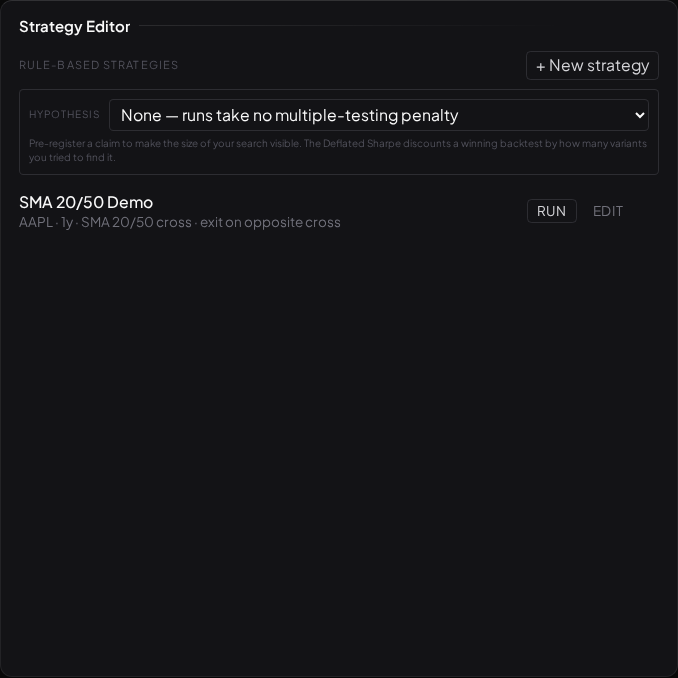
Composing a rule
The Strategy Editor builds a strategy from two decisions: an entry and an exit.
- Entry — what has to be true to open a position. A moving-average crossover (
fastcrosses aboveslow), an RSI-oversold reading, or a free-form condition in the strategy script language (CLOSE > EMA(200) AND RSI(14) < 60, and the like). - Exit — how you get out. The opposite of your entry signal, or a fixed take-profit / stop-loss pair.
Pick a symbol and a lookback range, and the engine runs the rule bar-by-bar, filling at the next bar's open after each signal — no peeking at prices the rule could not have known. The run card gives you return, win rate, profit factor, drawdown, and a trade list. That headline is the least important output, and treating it as the answer is the first mistake.
The part that separates testing from fooling yourself
The Backtesting in Visor lesson makes the case in full; here is the discipline in four rules:
- Decide the rule before you look. Write down the entry, exit, symbol, and range first. If you tweak the rule after seeing the result, you are no longer testing it — you are fitting it, and the backtest stops meaning anything.
- Read the robustness report, not the return. A green headline that fails the random control is a red result. Every strategy in this track made that exact mistake look tempting.
- Count your attempts. Every variant you try is another lottery ticket. If it took you twenty tweaks to find a "winner," the deflated Sharpe and multiple-testing bar it must clear is far higher than one — because you have been curve-fitting whether you meant to or not.
- Distrust a tiny or a huge trade count. Too few trades (eight, like the mean-reversion rule) and there is nothing to conclude; suspiciously many for a "selective" rule usually means it isn't selective at all.
Try it
Loaded below is a deliberately ordinary example — a 10/30 moving-average crossover on SPY — so you have something to run immediately. It is not a recommendation and almost certainly will not pass; it is a starting point to change. Run it, open the Robustness tab, and watch what the gates say. Then change one thing, form a view about whether that change should help before you run it, and see whether the gates agree. That loop — hypothesis first, gates second — is the whole method.
The honest goal
The aim of building your own is not to discover a money-printer; the base rate for that, as this track has shown on six famous strategies, is brutal. The aim is to build the habit that protects you: forming a clear hypothesis, testing it once, and letting an adversarial check — the random control and the held-out split — overrule your enthusiasm. A trader who does that reliably is doing something rarer and more durable than any single strategy: they are refusing to be fooled by their own backtests.
What to read next
- Backtesting in Visor — the full mechanics of the engine and the run card.
- Reading a Robustness Report — the four gates, in detail.
- Why Most Strategies Fail the Gate — the base rate you are up against.