Options · advanced · 9 min
Black-Scholes
The Black-Scholes-Merton model is the closed-form formula that turned options from a specialist's craft into something you can price on a calculator. It is the engine under Visor's Options Calculator, and understanding what it does — and, more importantly, what it assumes — is what separates a number you trust from a number you take on faith.
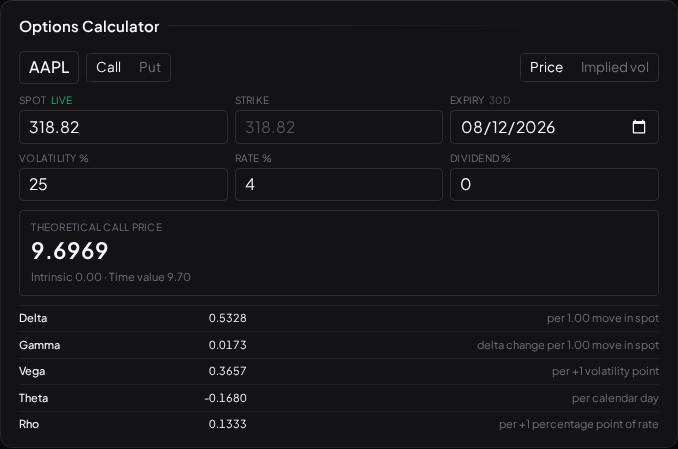
This is an advanced lesson. It won't derive the formula (that needs stochastic calculus), but it will make honest what the model gives you and what it quietly leaves out.
What the model computes
Feed the model six inputs and it returns one output. The inputs:
- Spot — the current price of the underlying.
- Strike — the contract's fixed price.
- Time to expiry — how long is left.
- Volatility — how much the underlying is expected to move, annualised.
- Risk-free rate — the return on a safe asset over the horizon.
- Dividend yield — income the underlying pays out (a continuous rate in this version).
The output is a single theoretical price: the model's estimate of what the option is worth today. Because the formula is a smooth function of its inputs, you can also differentiate it, and those derivatives are the greeks from The Greeks — delta, gamma, theta, vega, rho, and the second-order charm and vanna, all closed-form.
The core idea is elegant. The model imagines continuously hedging the option with the underlying so that, instant to instant, the combined position carries no directional risk. If that hedged position is riskless, it must earn the risk-free rate — and that "no free lunch" constraint pins down a unique fair price. The famous formula is the solution to that argument.
The assumptions — and where each breaks
The model's price is only as good as its assumptions, and Visor's own documentation is upfront that these are real limits, not fine print. Each one is a place the number can drift from reality:
- European exercise. The model assumes the option can only be exercised at expiry. But most single-stock options are American and can be exercised any time — that early-exercise right has value the model doesn't count, so it misprices American options by the early-exercise premium. The calculator flags this directly.
- Constant volatility. The model takes one volatility number for the whole life of the contract. Reality has a volatility smile/skew — different strikes trade at different implied vols — and volatility itself changes over time. One number cannot capture a curve; this is the single biggest gap, and the Implied Volatility lesson is built around it.
- Continuous dividend yield. Dividends are modelled as a smooth trickle, not the discrete dates on which real dividends actually pay. Around an ex-dividend date the approximation frays.
- Constant risk-free rate. One fixed rate for the horizon; real rates move.
- Frictionless, continuous trading. The hedging argument assumes you can trade continuously with no fees, no spread, no gaps, and infinite liquidity. Real markets have all four, and they gap — prices jump discontinuously, which the model's smooth-diffusion assumption of price movement does not allow for. Fat tails and crashes are precisely the events it under-weights.
The through-line: Black-Scholes assumes a tidy world, and markets are not tidy. The tidiness is exactly why the formula is solvable — and exactly where it lets you down, usually at the worst moment.
What the number is, and is not
Visor states the output plainly, and it is worth repeating: the model price is a model estimate under those assumptions — not a quote, not a price you can trade at, and not a recommendation. The maths runs in the browser, closed-form, and is unit-tested against published textbook reference values and against numerical derivatives of its own price function — so it is a faithful implementation of the model. But a faithful implementation of a simplified model is still a simplified model. Faithful to the maths is not the same as faithful to the market.
How the market answers back
Here is the elegant twist. Because the formula has one input nobody can observe directly — volatility — traders run it backwards. Take the option's actual market premium as given and solve for the volatility that makes the model reproduce it. That solved number is the implied volatility, and the Options Calculator has an implied-vol mode that does exactly this: enter the market premium, and it inverts the model (Newton-Raphson on vega, with a bisection fallback in the deep wings where vega collapses) to recover the vol, then re-derives every greek at that solved value.
That inversion is how the "constant volatility" assumption gets quietly patched in practice: each strike and expiry gets its own implied vol, and the collection of them traces the smile the single-number model can't produce. The model becomes less a price oracle and more a language for quoting prices — which is the honest way to use it.
What to read next
- Implied Volatility — running the model backwards, and what the smile tells you.
- The Greeks — the derivatives of this formula, in detail.
- Options Risk — why "the model says it's cheap" is a dangerous sentence.