Options · intermediate · 9 min
Options Risk
Options are a genuinely high-risk instrument. That is not a disclaimer to skim past — it is the most important thing in this track, and this lesson exists to say it plainly. Options let you be wrong faster, and in more ways, than owning the underlying does. This lesson is the bridge from the mechanics to the Risk & Psychology track, because the maths and the mindset are the same subject here.
Leverage cuts both ways
A single option controls a large amount of underlying for a small premium. That is leverage, and it is the whole appeal — a modest move can multiply your outlay. But the same lever runs in reverse. A 10% move against the underlying can wipe out an out-of-the-money option entirely. The capped-loss story from What Is an Option is real — a buyer cannot lose more than the premium — but "only" losing 100% of what you put in, repeatedly, is how accounts empty. Capped per trade is not safe in aggregate.
The three ways to be wrong at once
Owning the underlying, you can be wrong about one thing: direction. Holding an option, you can be wrong about three at the same time:
- Direction — the underlying moves against you.
- Time — you were right, but too slowly. Time value bleeds out via theta (Intrinsic and Time Value) while you wait, and the bleed accelerates into expiry.
- Volatility — you were right about the move, but implied vol was already pricing it, so when the event resolves IV collapses (vol crush) and the vega loss swamps your directional gain (Implied Volatility).
You can call the direction correctly and still lose money on two of the other three counts. That is the trap that surprises almost everyone new to options, and it is structural, not bad luck.
The seller's tail
Selling options flips the risk shape into something more dangerous. A seller collects the premium up front — a small, likely gain — in exchange for an obligation whose loss can be many times the premium taken in. Selling a naked call has, in principle, unlimited loss as the underlying rises; selling a put risks the whole distance to zero. The payoff feels like winning often for a little, until the one move that takes back months of premium in a session. "High win rate" and "high risk" are not opposites — a strategy can be both, and short-option strategies frequently are. This is exactly where Risk of Ruin and honest Position Sizing stop being abstractions.
Dealer positioning and GEX — an analytical lens, not a signal
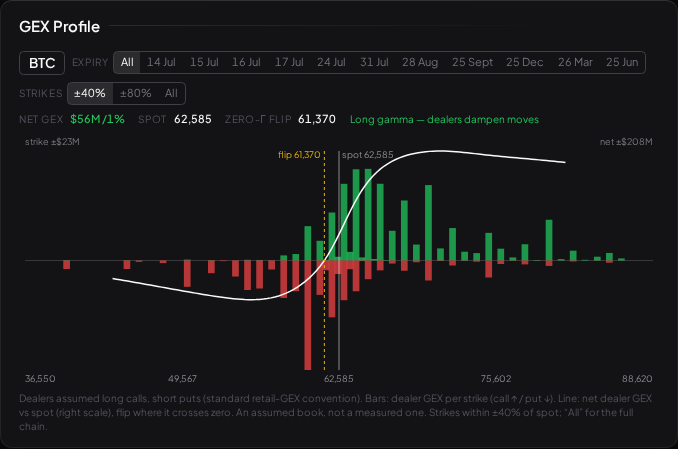
You will run into gamma exposure (GEX) and "dealer positioning" everywhere options get discussed online, usually dressed up as a crystal ball. Visor includes a GEX Profile widget, and it is worth being scrupulously honest about what it is and is not — because this is the single most misused idea in retail options.
What the widget shows: dealer gamma exposure across the live BTC chain — per-strike bars showing where gamma concentrates, a net-GEX-vs-spot line, and a zero-gamma flip, the spot level at which net dealer gamma is modelled to cross from positive (the assumption being dealers dampen moves there) to negative (they amplify). The flip is re-derived on a spot grid, recomputing each option's gamma at the shifted spot with the same Black-Scholes maths as the calculator.
Now the caveats, which are load-bearing:
- It is a modelled estimate, not a measurement. The single biggest assumption is who holds what. GEX uses the standard retail sign convention — dealers assumed long calls, short puts — and Visor's widget says so in plain sight on every view: it is an assumed book, not a measured one. Nobody outside the dealers actually knows their positioning. If the assumption is wrong, the sign of the whole picture flips.
- It is built on open interest, which tells you contracts outstanding, not who is long or short, not fresh flow, and not intent. The gamma numbers themselves come out of Black-Scholes and inherit every limit from the Black-Scholes lesson — constant vol, no gaps, a tidy world that crashes are not tidy in.
- It is widely misused as a forecast. "Price will pin to the flip", "we'll magnet to max gamma" — these are stories layered on a chain of assumptions, each of which can be wrong. GEX describes a modelled structure in the current open interest; it is not a prediction and never a signal to trade. Treat it as one lens with real uncertainty attached, not an answer.
The honest way to read GEX: it is a map of where a set of assumptions says dealer hedging pressure might sit — interesting context, defensible only as far as its assumptions hold, and dangerous the moment it is mistaken for what will happen. (Visor also offers a Greek Exposure Surface widget which deliberately reports charm/vanna exposure unsigned — no dealer long/short assumption at all — precisely because the positioning assumption is the shaky part.)
The psychology, honestly
Leverage compresses the emotional timeline. Gains and losses that would take weeks in the underlying arrive in hours, and fast feedback pushes overtrading, revenge trading, and abandoning a plan mid-position — the material of Common Biases. The instruments most capable of a large quick gain are the same ones most capable of a large quick loss and the poor decisions that follow one. There is no version of options where the reward is decoupled from that risk.
None of this is advice for or against trading options. It is the honest shape of the instrument: powerful, unforgiving, and easy to misread. If you take one thing from this track, take that the seductive parts and the dangerous parts are the same parts.
What to read next
- Position Sizing — the discipline that keeps leverage survivable.
- Risk of Ruin — why a string of capped losses still ends accounts.
- The Greeks — the sensitivities that make the three-way risk concrete.