Options · beginner · 6 min
Intrinsic and Time Value
When you pay a premium for an option, you are paying for two different things bundled into one number. Pulling them apart is the single most clarifying thing you can do as a beginner, because it explains almost every "why did my option lose money even though I was right?" story you will ever hear.
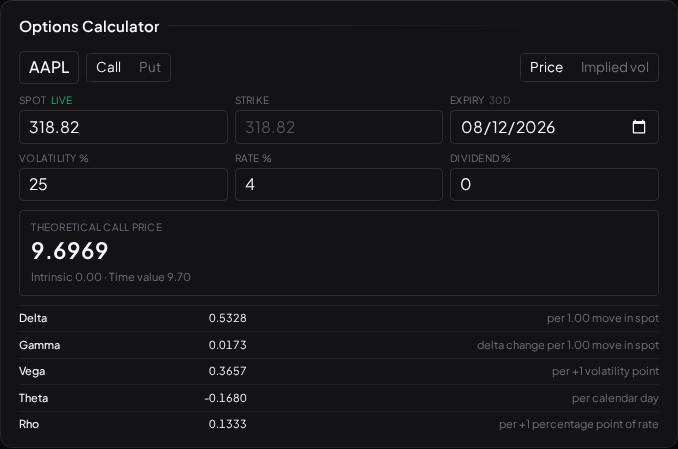
The premium always splits cleanly:
premium = intrinsic value + time value
The Options Calculator widget shows this split explicitly — every theoretical price it returns is broken into its intrinsic and time-value parts.
Intrinsic value: what it's worth right now
Intrinsic value is what the option would be worth if it expired this instant. It is the part that is already "real".
- For a call, intrinsic value is
price − strike, but never less than zero. - For a put, it is
strike − price, never less than zero.
So a call with a strike of 100 when the underlying trades at 115 has 15 of intrinsic value — the right to buy at 100 something worth 115. If the underlying were at 90 instead, the call has zero intrinsic value: the right to pay 100 for something worth 90 is worth nothing on its own. Intrinsic value can never be negative, because a right you don't have to use can't cost you anything to hold to expiry.
An option with intrinsic value is in the money. One with none is at or out of the money — and any premium it carries is entirely time value.
Time value: what you pay for the maybe
Time value is everything in the premium above the intrinsic part. It is the price of possibility — the chance that, between now and expiry, the underlying moves in your favour and the option gains (more) intrinsic value.
That out-of-the-money call with the underlying at 90 and a strike of 100 still trades for something — say 1.50 — even with zero intrinsic value. That 1.50 is pure time value: the market's price on the possibility that the underlying climbs above 100 before expiry. You are, quite literally, buying a maybe.
Time value is largest for at-the-money options, where the outcome is most uncertain, and it shrinks as an option goes deep in or deep out of the money, where the outcome is more settled.
Why time value bleeds away — theta
Here is the part that catches people. Time value decays as expiry approaches, and it decays whether or not the underlying moves. Less time left means fewer chances for the "maybe" to come good, so the maybe is worth less each day. At the moment of expiry, time value is exactly zero — an option is worth precisely its intrinsic value and not a penny more.
This bleed is called time decay, and its rate is the greek theta (covered in The Greeks). It is why you can be right about direction and still lose: if you buy an out-of-the-money option and the underlying drifts your way slowly, time value can erode faster than intrinsic value builds. You were right, but not fast enough — and time value doesn't wait.
Crucially, decay is not linear. Time value erodes slowly when expiry is distant and then accelerates sharply in the final weeks, which is why short-dated options are so unforgiving.
Seeing it in the calculator
Load the Options Calculator, set an out-of-the-money strike, and watch two things:
- Reduce the expiry (bring it closer) with everything else fixed. The theoretical price falls — you are watching time value drain.
- Change nothing but the volatility input upward. The price rises — more expected movement makes the "maybe" more valuable, which is the whole subject of the Implied Volatility lesson.
The value-vs-spot curve in the widget makes the split visual: the option's worth today sits above its payoff at expiry, and the gap between the two lines is the time value. As expiry nears, that gap closes onto the payoff line.
The honest takeaway
Buying an option is buying a decaying asset. The intrinsic part is solid; the time-value part is a wasting good you are renting from the writer, and the writer collects it as it wastes. None of this makes options good or bad — it makes them time-sensitive, and understanding that split is the difference between being surprised by a loss and understanding one.
What to read next
- The Greeks — theta, and the other sensitivities that move a premium.
- Implied Volatility — why the "maybe" costs more some days than others.
- What Is an Option — a refresher on the contract itself.