Options · beginner · 6 min
What Is an Option
An option is a contract. It gives the buyer the right, but not the obligation, to buy or sell an underlying asset at a fixed price on or before a fixed date. That one word — right, not obligation — is what separates an option from simply owning the asset, and it is where all the behaviour that follows comes from.
Options are among the more complex and higher-risk instruments an ordinary trader can touch. This track teaches how they work so you can read them honestly. It is not a nudge to trade them, and the Options Risk lesson is blunt about how fast they can go wrong.
The two kinds
There are two basic contracts:
- A call gives the holder the right to buy the underlying at the fixed price.
- A put gives the holder the right to sell the underlying at the fixed price.
For every buyer there is a seller (also called the writer), who takes the other side. The writer receives money up front and, in exchange, takes on the obligation to honour the contract if the buyer chooses to exercise it. Buyer's right, writer's obligation — the two sides are not symmetrical, and that asymmetry matters enormously for risk.
The four terms that define a contract
Every option is pinned down by four things:
- Underlying — what the contract is written on: a stock, an index, or in Visor's first live chain, Bitcoin.
- Strike price — the fixed price at which the holder may buy (call) or sell (put). This is the reference point everything is measured against.
- Expiry — the date the right ends. After expiry the contract is worthless or settled; there is no "waiting for it to come back".
- Premium — the price the buyer pays the writer for the contract, up front. This is the amount of money actually at stake for the buyer.
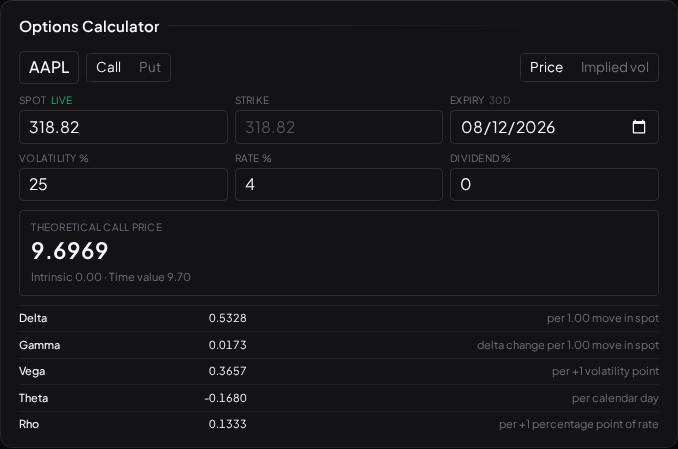
State those four and you have described the contract completely. The Options Calculator widget takes exactly these inputs — symbol, strike, expiry, and so on — and returns what the contract is theoretically worth.
A worked feel for it
Suppose a stock trades at 100. You buy a call with a strike of 105, expiring in a month, for a premium of 2.
- If the stock finishes at 120, your right to buy at 105 is worth 15 per share. You paid 2, so you are ahead.
- If it finishes at 103, the right to buy at 105 is worthless — nobody exercises the right to pay more than the market price — and you lose the 2 you paid.
- If it finishes anywhere below 105, same story: the call expires worthless and the 2 is gone.
Notice the shape. Your loss is capped at the premium (the 2), but the writer who sold you that call has taken the mirror position: they kept the 2, but their loss is open-ended as the stock rises. Options rearrange risk; they do not remove it. They just move it around and, for sellers, can concentrate it.
Moneyness: in, at, and out of the money
A quick vocabulary you will meet everywhere:
- In the money (ITM) — exercising now would have value. A call is ITM when the price is above the strike; a put when the price is below it.
- At the money (ATM) — the price sits right at the strike.
- Out of the money (OTM) — exercising now would be pointless. The 105 call above, with the stock at 100, is OTM.
Moneyness is descriptive, not a verdict. An OTM option is not "bad" and an ITM one is not "good" — they are different instruments with different odds and different prices, and the whole point of the next few lessons is to see why they cost what they cost.
American vs European
One footnote that turns out to matter for the maths. European options can only be exercised at expiry; American options can be exercised any time up to it. Most single-stock options are American; many index options are European. Visor's calculator uses the European (Black-Scholes-Merton) model, which is why it flags that American options are mispriced by the early-exercise premium — a limit the Black-Scholes lesson returns to.
What to read next
- Intrinsic and Time Value — what you're actually paying for in that premium.
- The Greeks — how an option's value reacts as the world changes.
- Options Risk — why the capped-loss story is only half of it.