Reading the Tape · advanced · 8 min
Absorption and Exhaustion
The most-watched pattern in order flow is a simple mismatch: a lot of aggression, and no movement. When wave after wave of market orders hits a price and price doesn't budge, something is soaking it up. Traders call that absorption, and the moment the aggressive side runs out of ammunition is exhaustion. This lesson is about reading both — and about why "reading" is the honest limit of what you can do with them.
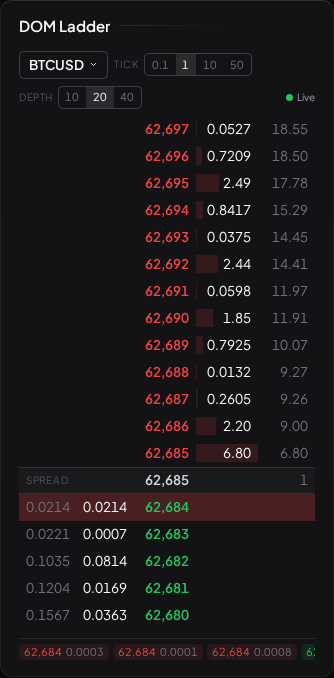
You'll want The DOM Ladder, Time and Sales, and Liquidity Heatmaps under your belt first, because absorption is precisely the interaction between the two sides those lessons cover.
Absorption: aggression meeting a wall
Normally, aggressive orders move price. Buyers lift the offer, the offer clears, the best offer steps up, price rises. Absorption is when that stops working: aggressive buying keeps printing on the tape, keeps eating the offer — and the offer keeps refilling just as fast, so price stays pinned.
On the DOM you see it as a resting order that gets partly consumed and then tops back up, again and again, holding its level. On the heatmap you see a bright band that stays lit while trade bubbles pour into it. What it means, in plain terms: a large passive participant is willing to keep filling at that price, and the aggressive side is spending itself against a wall that won't give.
The reason traders care is the implied asymmetry. If aggressive buyers throw everything at a level and it holds, the buyers are exhausting themselves while a seller quietly accumulates the other side. When the aggression is spent, there may be little left to push price up — and it can roll the other way. That's the logic. Notice it is a description of a mechanism, not a rule that fires. Sometimes the wall is what breaks.
Exhaustion: the push that runs out
Exhaustion is the flip side, read on the aggressive party. A strong move runs on heavy one-sided prints — then the prints thin out, the size behind them shrinks, and price stalls even though nothing is obviously stopping it. The move didn't hit a wall; it simply ran out of participants willing to keep paying up.
On the tape, exhaustion often looks like a fast, large-print run decaying into small, sporadic prints. On the heatmap, it can look like price pushing into thinner and thinner liquidity with less and less trade size behind each step. The story is that the fuel is gone — the last aggressive buyers have bought, and there's no one left to lift the next offer.
Absorption versus exhaustion
They're cousins and often occur together, but the distinction is worth holding:
- Absorption is about the passive side — someone is actively soaking up the aggression at a fixed price.
- Exhaustion is about the aggressive side — that side is simply running out, wall or no wall.
In practice you'll often see aggression get absorbed at a level and then exhaust — the wall holds long enough that the pushers give up. That combination, at a level you already care about, is why these patterns get so much attention.
The honest problems
Here is where this lesson has to be careful, because absorption is exactly the kind of pattern that looks obvious in hindsight and is treacherous live.
- You can't see who's behind the wall, or whether they'll stay. A refilling order might be one determined participant — or an algorithm that will pull the instant it's tested harder. The read that "a big seller is absorbing here" is an inference, not an observation. It can be wrong.
- Absorption that fails is a breakout. The same picture — heavy aggression into a held level — precedes both "the wall holds and price reverses" and "the wall finally cracks and price runs." You do not know which until after. A pattern that resolves both ways is not a signal.
- It doesn't backtest. Unlike a rule on candles, "the offer was absorbing" can't be encoded and run against history for an honest win rate. There's no random control for a discretionary tape read. That doesn't make it worthless — it makes it un-provable, which is a different and important thing to be clear-eyed about.
Reading it honestly
Absorption and exhaustion are genuine, mechanical phenomena — size really does get soaked up, pushes really do run out of fuel. Read as a lens on a level you already have a structural reason to watch — a supply or demand zone, a prior support level — they can sharpen your sense of whether that level is being defended or given up right now. Read as a standalone "absorption means reverse" signal, they will hurt you, because the failed version looks identical until it's too late. Describe what you see; don't let the tape tell you what to do. The Tape in Context is the full version of that argument.
What to read next
- Spoofing and Fakes — why the wall doing the absorbing might not be real at all.
- Liquidity Heatmaps — watching a band hold or break over time.
- Support and Resistance — the structural levels absorption is worth reading at.