Reading the Tape · advanced · 8 min
Spoofing and Fakes
Everything on the DOM ladder and the liquidity heatmap shares one weakness: a resting order is only a stated intention, and intentions can be withdrawn for free. That single fact is the crack that fake liquidity lives in. This lesson is about staying sceptical of the book — reading it as a set of claims, some of which are bluffs.
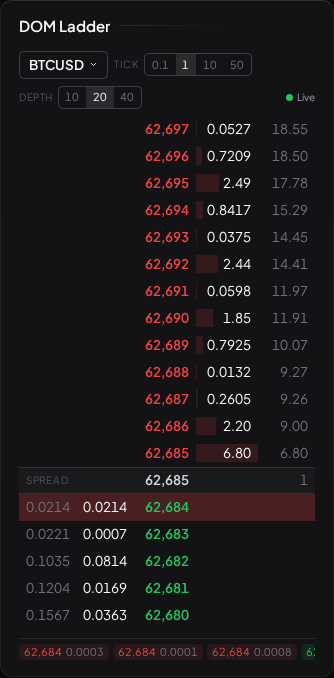
The order that was never meant to fill
A limit order sitting in the book costs nothing to place and nothing to cancel. It fills only if price reaches it and there's aggression to match it. That means a participant can place a large, visible order with no intention of ever letting it fill — purely to be seen. The order is a message, not a trade.
Why send such a message? Because other participants read the book and react to it. A large resting bid looks like support; traders lean on it, place their own orders near it, pull their offers. A large resting offer looks like a ceiling; it discourages buying. If you can put size in the book that makes others behave a certain way, and then cancel it before it fills, you've moved the market with an order you never had to honour.
Spoofing, specifically
Spoofing is the deliberate version: placing large orders with the intent to cancel before execution, to create a false impression of supply or demand and nudge price. In regulated markets — futures, equities — spoofing is illegal market manipulation, and prosecutions have followed. This lesson is not teaching you to do it; it's teaching you to recognise that it happens, so you don't take the ladder at face value. Not every large order that gets pulled is spoofing — participants legitimately change their minds constantly — but the effect on your read is the same either way: the wall you were leaning on was never load-bearing.
What a fake looks like
You can't prove intent from a screen, but certain behaviours are how fake liquidity tends to show up:
- A wall that pulls on approach. A big resting order sits a few ticks away, looking like solid support — and vanishes the instant price actually gets close. Real orders sometimes get cancelled too, but a wall that reliably evaporates before it can be tested is doing nothing but signalling.
- Flashing size. A large order that appears and disappears repeatedly, never sitting long enough to be hit. It's there to be seen on the heatmap and the ladder, not to trade.
- Asymmetry between book and tape. The DOM shows a huge bid, but the time-and-sales tape shows nothing actually trading there when price visits. Big claimed size, no matching prints, is a tell that the size was never real interest.
- Size that doesn't refill after it's hit. Genuine absorption tops itself back up. A spoof, once it's accidentally hit, usually just disappears — the participant didn't want that fill.
The tape is harder to fake
This is why time and sales is such a useful counterweight to the book. Resting orders are cheap talk; executed trades are not. A print is a completed transaction that cannot be cancelled. You can fake the appearance of demand by stacking bids you'll pull — you cannot fake demand by actually buying, because actually buying costs money and moves price. So when the book and the tape disagree — heavy resting size but no prints to back it — trust the tape. Real conviction shows up as trades, not as orders that flee on contact.
Staying sceptical without being paralysed
The lesson is not "the book is all lies." Most resting liquidity is real, and the book is genuinely informative — otherwise no one would watch it. The lesson is that you should treat a large visible order as a claim to be verified, not a fact. The verification is behaviour: does it hold when tested? does it refill? do prints actually trade against it? A wall that stands up to those questions is worth respecting; one that fails them was scenery.
And note the deeper point, which the next lesson carries: because visible liquidity can be faked and because real visible liquidity attracts hunting, the book is a place where participants actively try to mislead each other. That is a very different environment from a candle chart, and it demands a different kind of scepticism — not "what is this telling me" but "what is someone trying to make me think."
The honest frame
Fake liquidity is one more reason order flow is a lens and not a signal. You cannot build a mechanical rule on "spot the spoof" — intent isn't observable, and the same cancellation can be manipulation or an honest change of mind. What you can do is hold the ladder loosely, cross-check it against the tape, and refuse to lean your whole read on a wall that hasn't proven it will stand. Read the book as testimony from interested parties, and weigh it accordingly. The Tape in Context closes the loop.
What to read next
- The Tape in Context — why order flow is a lens, not a signal, and where it misleads.
- Liquidity Sweeps — how visible pools of real orders get hunted.
- Time and Sales — the executed-trade record that's far harder to fake.