Using Visor · advanced · 8 min
The Greek Surface
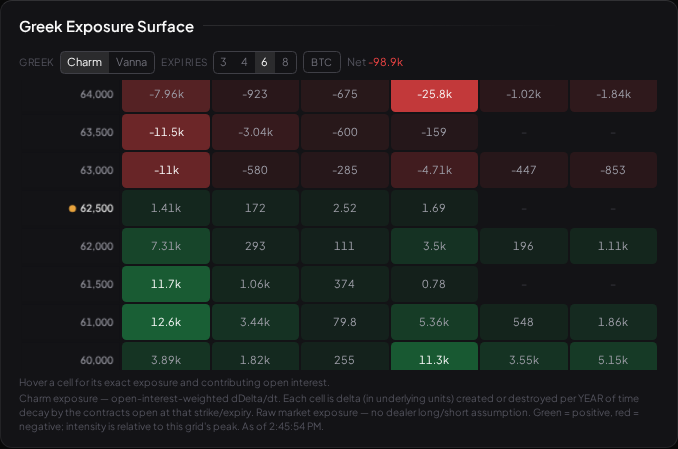
The GEX Profile reads one greek (gamma) under an assumption about who holds it. The Greek Surface widget reads two others — charm and vanna — and deliberately makes the opposite choice: no positioning assumption at all. That single design decision is the whole reason to reach for it, so it's worth understanding what it shows and why the "unsigned" framing matters.
It reads the live BTC options chain (Deribit today), the one live chain Visor carries.
Charm and vanna, practically
The Greeks lesson defines these second-order sensitivities; in practice:
- Charm is how an option's delta drifts as time passes — delta decay per year of time. It tells you how your directional exposure changes just from the clock ticking, even if nothing else moves.
- Vanna is how delta changes as volatility changes — delta sensitivity to a shift in implied vol.
They matter little for a single position and a great deal in aggregate, which is exactly what this widget shows: where charm or vanna exposure piles up across the whole chain.
Reading the heatmap
The surface is a table: strikes down the rows (high at the top, options-ladder convention), the nearest expiries across the columns (nearest first). Each cell is coloured by the open-interest-weighted greek at that strike and expiry:
- Green is positive, red is negative, and intensity is relative to this grid's own peak — the strongest cell anchors the scale, so colour reads as "how big relative to what else is on screen right now."
- The spot row is marked with a live dot and centred when the widget opens, so the near-money action is where your eye lands rather than scrolled off at the far-OTM top.
- Hover any cell for the exact exposure, its units, and the open interest behind it — how many contract legs contributed and the total OI. A big-looking cell built on a handful of legs reads differently from one built on deep open interest, and the hover readout is there so you can check.
- The Net chip in the controls sums the exposure across the whole visible grid.
Two controls: Greek switches between charm and vanna, and Expiries picks how many nearest expiries to show (3, 4, 6 or 8) — far-dated LEAPS are dropped this way so the grid stays dense near the money instead of ballooning into empty far cells.
The units, stated honestly
Each cell is that greek summed over the open interest at the node, in delta-equivalent units of the underlying:
- Charm surface — underlying-delta created or destroyed per year of time decay by the contracts open there.
- Vanna surface — underlying-delta gained or lost per 1.00 (100 vol-point) move in implied vol.
Unsigned — the deliberate contrast with GEX
Here is the design choice that defines the widget. Unlike the GEX Profile, the Greek Surface imposes no "dealers long calls, short puts" assumption. Each contract's own signed charm or vanna is used as-is and summed over the open interest — so a cell is raw market exposure held in open interest, not a modelled dealer book. Calls and puts already carry naturally opposite-signed charm and vanna, so the sum is meaningful on its own without anyone having to guess who is on which side.
That makes it the honest counterpart to GEX. GEX's most fragile step is the positioning assumption; the Greek Surface simply doesn't take it. What you gain is defensibility — the number is what the open interest is, not what a model assumes about who holds it. What you give up is the dealer-hedging narrative, which is the part that was never measured anyway.
So read a cell as: this much charm or vanna exposure is sitting in the open interest at this strike and expiry. It is a description of where second-order exposure concentrates on the live chain. It is not a dealer-positioning model, and — like everything in this track — not a signal.
What to read next
- The Greeks — charm and vanna defined, alongside the first-order five.
- The GEX Profile — the same chain read with a dealer assumption, and why that's the shaky part.
- Options Risk — how these exposures fit the honest picture of the instrument.